Problem
Company financial (and financially relevant) data is spread across multiple systems: CRM, ERP, HRIS, data warehouse, company database, and sometimes more. Being able to constantly and accurately synthesize this data, extract insights, create forecasts, re-forecasts, enable dynamic budgets, and build ongoing reports for executives and the board becomes an absolute nightmare for finance teams.
Thesis
With the progress in AI, especially the release of ChatGPT 3.5, it seems clear that we should be able to create AI agents that can synthesize large amounts of company financial data. And with some additional fine-tuning and training, we will be able to create an AI FP&A analyst to perform some of these functions.
Defensibility
- If we build a co-pilot experience around these agents — i.e., the ability for a CFO to have their dashboards, scenario planning, and end-to-end workflows like a flux analysis or a Budget Variance analysis; it should give us enough of a moat that we stay away from foundation model companies
- If we meet teams where they work (Excel and PowerPoint), but do it with full access to their existing data stack, we make the product extremely sticky for them
- If we focus on building strong data integrations and proprietary data models that understand the nuances of financial data across different systems, we create switching costs that make it difficult for customers to move to competitors.
What we shipped (see product screenshots below)
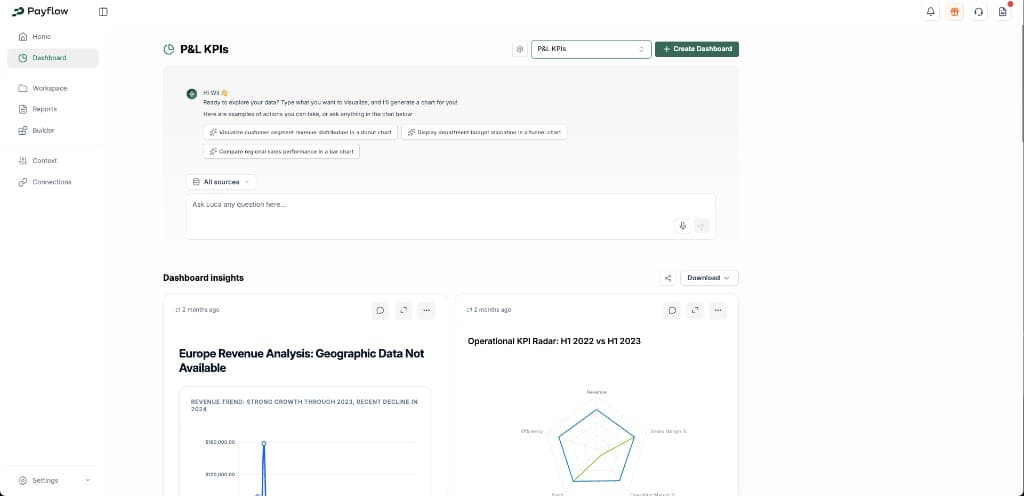
- Data connections and semantic data layer: 200+ API connections to ERPs, CRMs, HRIS, data warehouses along with a modeled data layer to create a singular source of truth per entity
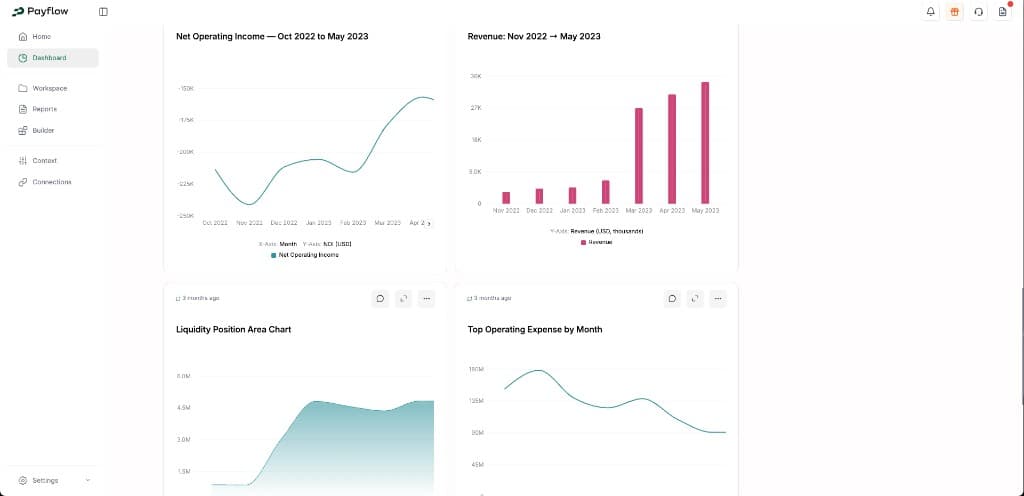
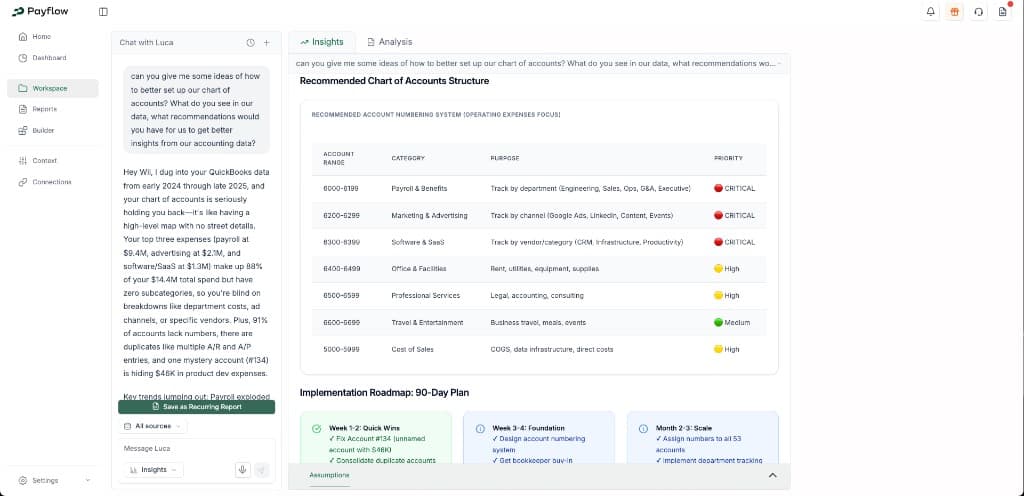
- Insights: Ask anything of Luca, your new AI analyst. Luca responds with detailed answers that include text, graphs and tables and provide you with executive-meeting level responses worthy of a senior analyst.
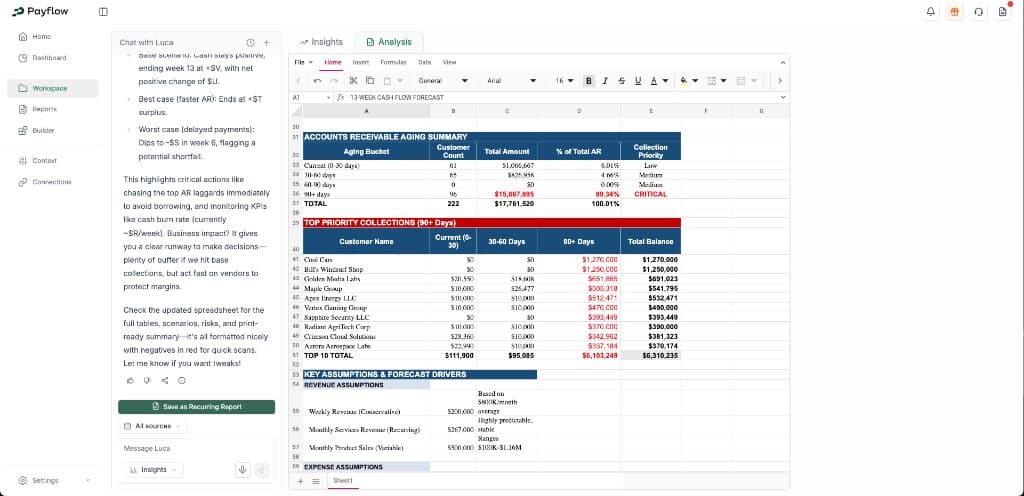
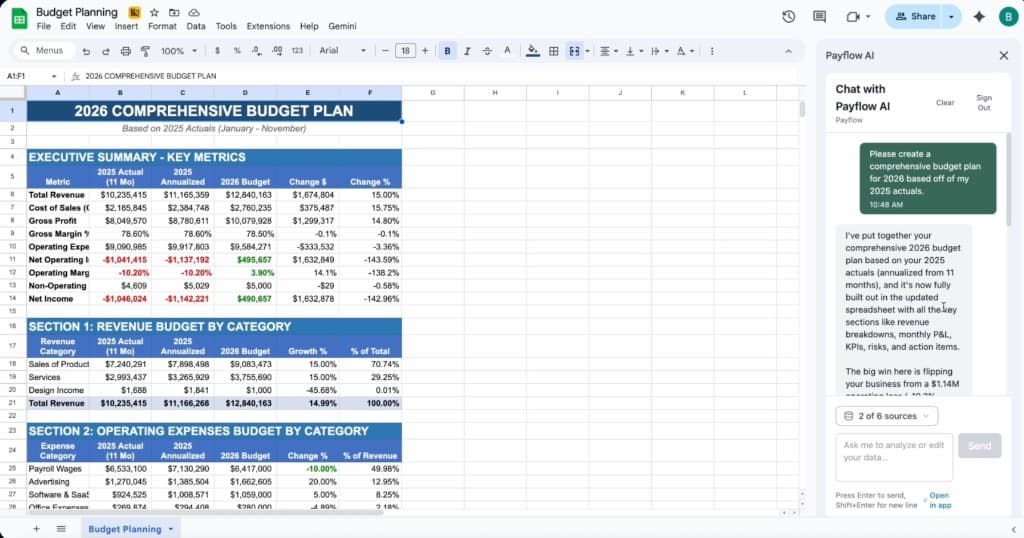
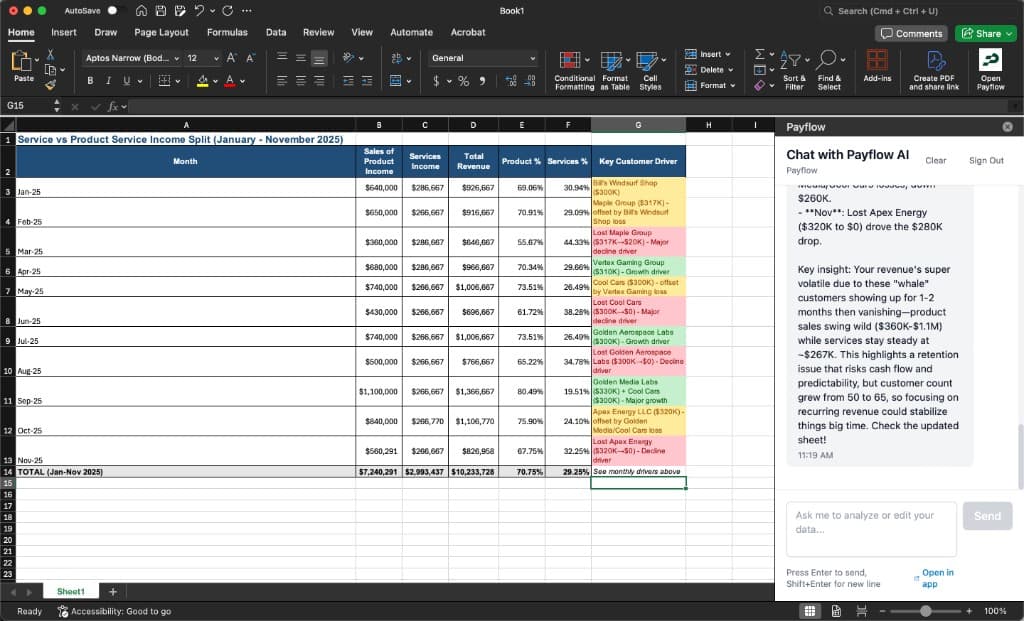
- Luca in Excel/Google Sheets: Luca can create or update complete analyses (e.g., Budget Variance Analysis) with detailed commentary. The agent can also analyze and update a forecast, budget, or create a continuous forecast based on the latest live data
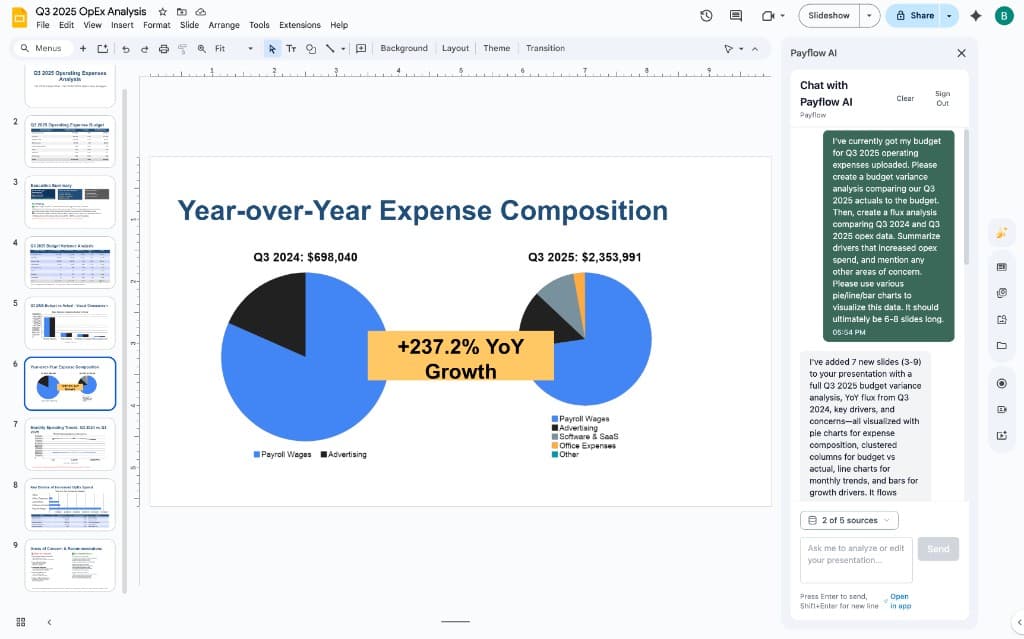
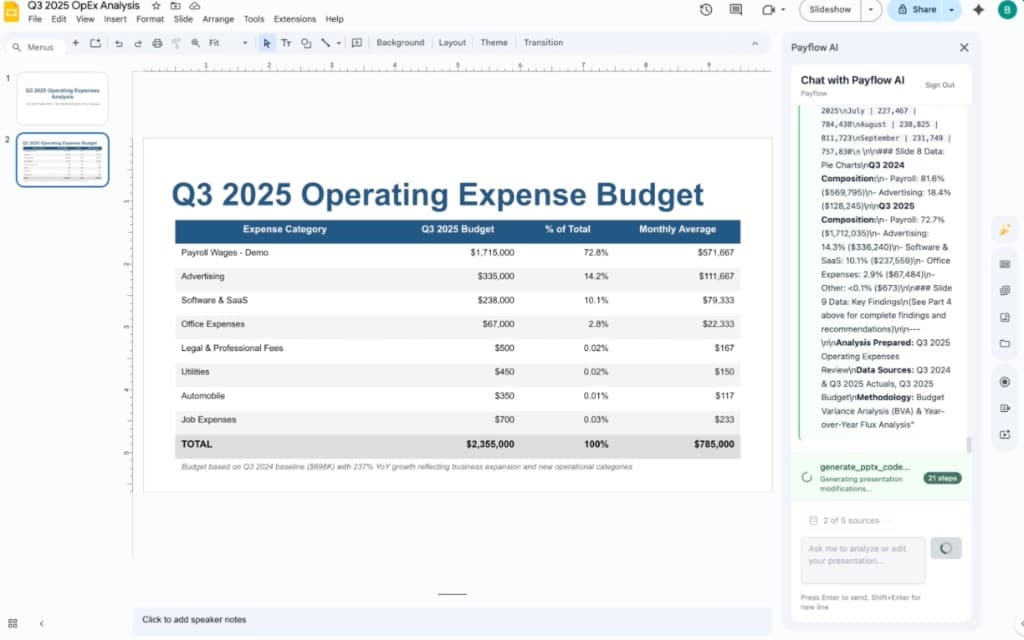
- Luca in PPT/Google Slides: Use Luca to update your board meeting or monthly financial report slides using properly sourced data from your systems
- Reports: Schedule any insight thread or analysis to be run automatically by Luca on a recurring basis. Need a monthly flux analysis? Work through it once with Luca then ask the agent to repeat every 5th of the month along with a detailed write up
How it was received
Most of our product releases at Payflow looked like magic to our customers:
- • an AI that can answer questions from my ERP — magic
- • an AI that can be in Excel and connected to my ERP and CRM — magic
- • being able to connect Netsuite and Snowflake and have an agent that understands how they both relate to each other and answer questions or update an analysis — magic
However, platforms like Anthropic were creating magic and coming down to FP&A at increasingly faster rate. Claude for Excel, Claude co-work, Claude Code, etc. And customer expectations were getting re-rated every month. The magic of April became the has-been of May leading to a constant “ok, what are you building next to justify the subscription price?”
Who we sold to?
Companies doing $5-200 million in revenue with at least one person on the finance team. We eventually tested the $2-5 million segment as well. We were able to sign multiple $100M+ revenue companies. A lot of our customers were non-tech companies that were private-equity backed and therefore had a ton of reporting requirements, but not enough resources to fulfill them. We also had a few fast-growing VC-backed customers.
Architecture
Python, React, DigitalOcean for Web App. LangGraph, DigitalOcean, Openpyxl, python-pptx, MongoDB, dbt, BigQuery for the agents.
Some observations that led us to pause the project
Disclaimer: I can't say much here due to confidentiality, but the main reasons we paused had more to do with funding dynamics. Everything below is solvable given enough resources... and a bit of time
- Time to activation was the biggest bottleneck. It started at 6 months; we brought it down to 3 months then eventually 6 weeks. This is because the platform is not valuable until the data is properly modeled from the various systems, then you have to run multiple tests (e.g., parsing 100-tab spreadsheets) and iterate to make sure the agents do not hallucinate. As a result, we had to constantly reactivate earlier cohorts
- ICP was extremely sensitive to early product bugs. We expected some bugs with the agent and placed companies on pilots to ensure issues were ironed out. Unfortunately finance teams would stop using the platform for 15-30 days every time they encountered an error. This exacerbated point #1
- Sales cycle was too long for the ACV. We were able to get contracts at $12-24k, but considering the 3-6 months sales cycles (and the cost of onboarding), we needed ACVs closer to $50k
- Customers were falling in love with the alternatives. We had regular customer check ins. The last few months, they would showcase how they were using the MCP with their ERP to answer any questions; how Claude Excel was “closer and closer” to our agent, Luca, and how excited they were for the MCP to be live in Excel, etc. When your top customers all speak like this; it's time to re-think your core insights
- Advanced model capabilities strengthened incumbents. When Sonnet 4 or Opus 4.5 can put together highly complex analyses, it makes every agent on the market look world class and chips away at your moat
What would I do differently today?
- • Hire our dream team MUCH earlier. The team I had at the end was excellent and we moved EXTREMELY fast. I should have hired them earlier instead of conserving runway
- • Invest in the “collaboration layer” earlier. Getting the platform where the CFO, head of FP&A, and even the other functional leaders (head of sales, head of operations, etc.) can collaborate to produce reports, update budgets, etc.
- • Have the agents be proactive from day 1. Proactive insights, proactive reports, proactive analyses, all based on user data. This would have tightened the feedback loop and been a better re-activation point
Product screenshots